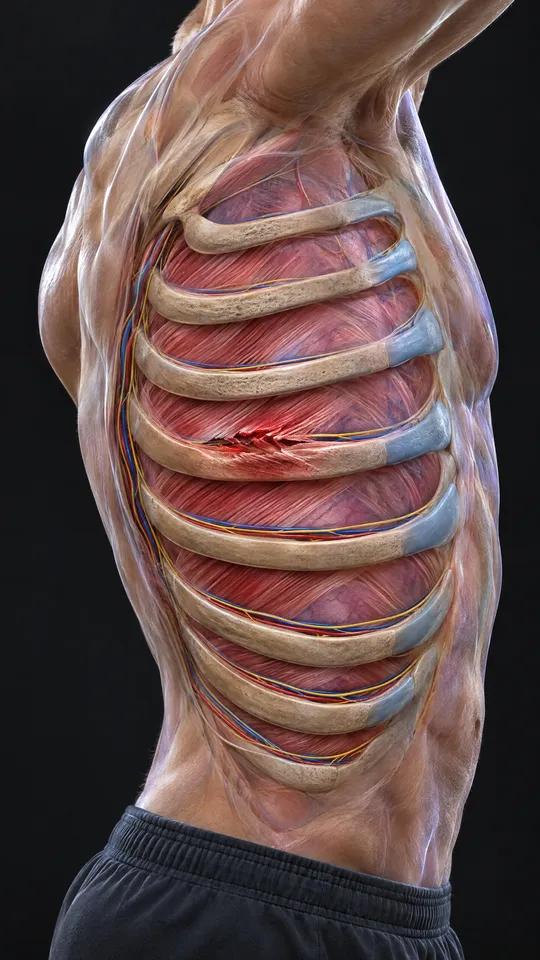
What's actually causing it
Between every pair of ribs sit the intercostal muscles. An intercostal strain is one of them stretched or torn 10, and it's a recognised cause of chest wall pain after an injury 7.
The signs are consistent: pain, sometimes with bruising or swelling, that gets worse when you take a deep breath, cough, laugh, sneeze or move a certain way 13. A useful clue: pressing on the sore spot, or a particular movement, reproduces the pain. On its own, though, that isn't enough to rule out a more serious cause 7.
The sporting version: side strain in fast bowlers and throwers. In cricket and baseball there's a more specific injury with the same everyday name. It typically happens during a single delivery or throw, and usually stops the athlete on the spot 5. What tears is the internal oblique, pulling away from the undersurface of one of the lowest four ribs or their costal cartilages 1,6. Less commonly the external oblique or transversalis is involved instead 5. It usually shows up on the side opposite the dominant arm 2,5.
Why it happens isn't fully worked out: the authors of one clinical paper say the biomechanics aren't yet understood 5. But across 207 first-class fast bowlers, side strain was not associated with bowling arm, height, trunk side-bending range or side-bridge endurance 3. The only association was how much first-class cricket had been played. So the familiar "weak core, tight side" story isn't supported. Bowling volume is.