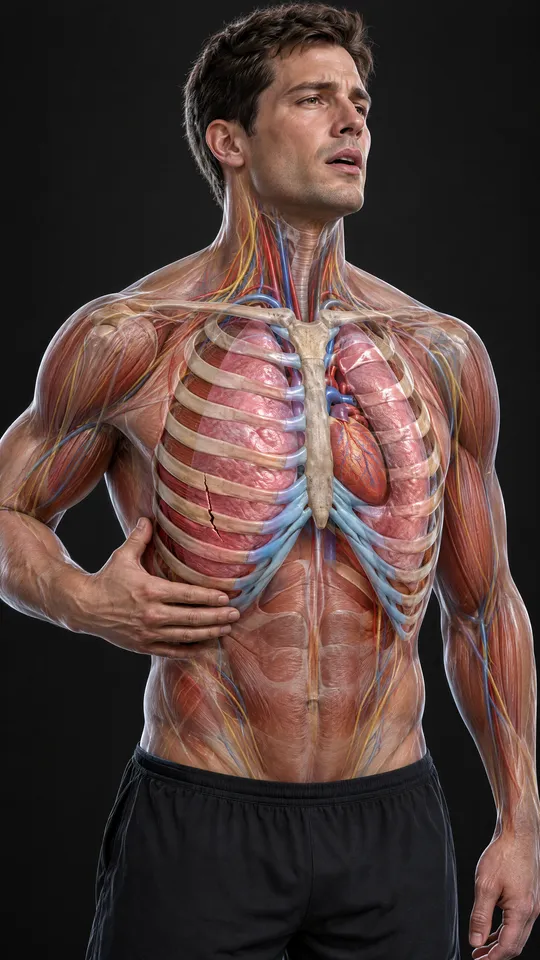
What's actually causing it
Your ribs form a cage around your lungs, and that cage moves every time you breathe. A broken wrist can be held still in a cast. A broken rib gets moved with every breath, which is why breathing in, coughing, sneezing and laughing all hurt 2.
A rib usually breaks where it was hit, or towards the back, where it's weakest 1. You may also notice a grating or crackling feeling as the broken ends move (called crepitus), muscle spasm around the area, and difficulty breathing 2. Older people break ribs more easily, because bone thins with age 2.
Why your breathing matters more than the bone. Treatment exists to manage the pain while the rib heals 2. The real concern is what that pain does to your breathing: it makes deep breaths and a proper cough hard work 2. NSW Health's guidance is blunt about it. Breathing exercises won't be effective unless your pain is controlled 1. So pain control comes first, and everything after it is built around breathing deeply, clearing your chest, and staying upright and moving 1. Breathing well while a rib heals matters, and our chest physiotherapy service covers the techniques.
It isn't always one simple break. The most common serious rib injury is flail chest: three or more ribs broken in at least two places, so that section of the chest moves the wrong way when you breathe 2. A broken rib can also come with a collapsed lung (pneumothorax) or an injury to the spleen 2. Those are problems for a hospital team, which is why a significant impact needs a doctor first.