Need urgent care? 24/7 Mobile & After-Hours Emergency Physiotherapy Call (02) 8111 5633 For life-threatening emergencies, always call 000
Ankle

Achilles Tendon Rupture

5.0 average rating on Google
Registered NDIS Provider
SIRA Registered Provider

You pushed off for a sprint, a jump or a quick step back, and something hit the back of your ankle. Since then, pushing your foot down feels weak and wrong.

That's how a rupture is often described: like a strike to the back of the ankle, sometimes with a popping sound 1. If this has just happened, call us today rather than waiting for it to settle. We assess the tendon and refer you the same day for the boot, imaging or specialist review it needs. Ideally the ankle goes into a cast or boot, toes pointed down, within hours, with specialist review within seven days 2.

What's actually causing it

A rupture happens when a sudden load takes your Achilles past what it can handle: jumping, or a sudden burst of running 1. Up to 90% occur during an acceleration-deceleration movement 2.

It follows a pattern. Estimates range from 11 to 37 cases per 100,000 people, men are more than twice as likely as women, and there are two peaks: people aged 25 to 40 playing high-energy sport, and people over 60 2.

Certain antibiotics are also linked to rupture 1, specifically the fluoroquinolone group, such as ciprofloxacin, with a rupture possible anywhere from 2 to 60 days after starting them 2.
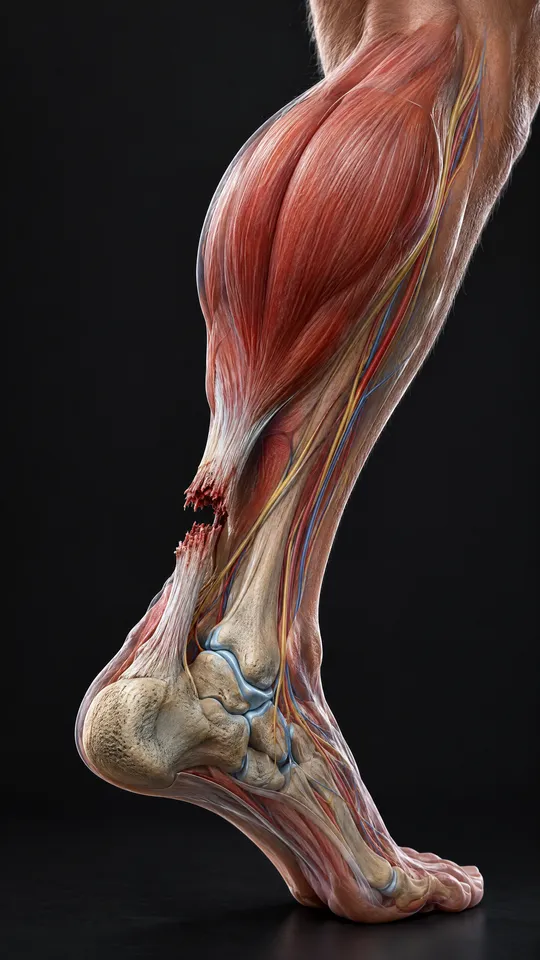

Side of the lower leg showing the Achilles tendon torn through above the heel

Achilles rupture or tendinopathy? How to tell the difference

Tendinopathy is a long-term condition built up from repeated small tears over time; a rupture is an acute injury, where the tendon is stretched past its range in one go 1. Tendinopathy tends to niggle for weeks. A rupture usually has a moment you can point to.

Not every tear goes all the way through. Partial tears exist, and when an examination leaves doubt, ultrasound is preferred over MRI to tell a partial tear from a complete one 2. If your pain has built up gradually instead, Achilles Tendinopathy is the better place to start.

How it's diagnosed

A complete rupture can usually be picked up from your symptoms, how it happened and a doctor's examination, so a scan often isn't needed 1 5. The doctor feels along the tendon and calf 1 for a gap, which usually sits 4 to 5 cm above the heel bone 5. One thing catches people out. After the first sudden pain, it can settle to a dull ache or go completely 5, so pain easing off doesn't mean the tendon is intact.

If the examination leaves any doubt, an ultrasound can confirm the diagnosis and show exactly where the tear is 2 5. MRI isn't the usual next step: the author of an Australian review written for GPs doesn't routinely use it for a fresh rupture 2.

How we treat it

1
Recognising it first. If you come to us with a suspected rupture, our job that day is to check for it, not to treat it on the table. Clinicians look for three signs: how your foot hangs at rest, a gap you can feel in the tendon, and whether squeezing your calf moves your foot. Two of those three together have been reported to pick up every rupture 2. If they're there, we send you straight on for immobilisation and medical review 2.
2
Rehab once the boot phase allows it. With or without surgery, the long part of recovery is the rehabilitation. With functional rehab and early movement, re-rupture rates with and without surgery weren't significantly different 4. In one published hospital protocol, physiotherapy starts around week 7 5. Your specialist sets that timeline; we work to it.
3
Rebuilding strength, then getting back to sport. How soon you return depends on your sport and how much strength you've regained 5. Sports physiotherapy is where we build that back and plan a graded return.
4
After a surgical repair. If your tendon was repaired, the rehab that follows sits under post-surgical rehabilitation. Return to sport after surgery is typically around 6 to 9 months 4.

The surgery question, honestly. In a trial of 526 patients, surgery wasn't associated with better outcomes than non-surgical treatment at 12 months 3. There's a trade-off: re-rupture was 6.2% without surgery against 0.6% with it, but nerve injury was 0.6% without surgery against 2.8% to 5.2% with it 3. A review of 29 studies found the same pattern: fewer re-ruptures after surgery (2.3% vs 3.9%), more complications (4.9% vs 1.6%, mainly infection) 4. That decision belongs to you and your orthopaedic specialist. We'll help you weigh it up.

Other treatments we may use

Manual therapy.

Hands-on work around the ankle and calf may be part of your sessions once your specialist has cleared the tendon for it. None of the research behind this page tested manual therapy for Achilles rupture, so it supports the strengthening work and doesn't replace it.

The boot and heel wedges.

Fitted early as part of the medical pathway 2. In one NHS protocol, three wedges come out one at a time between weeks 5 and 7, with about nine weeks in the boot overall 5. Follow the schedule you're given: the tendon stays vulnerable, and a sudden load such as a trip or a step up can re-rupture it 5.

Surgery.

Needed in some situations, but often not 1. It's performed by an orthopaedic surgeon, never by a physiotherapist.

Your recovery path: Reset, Rebuild, Return

Rehab after an Achilles rupture follows The Well Motion Recovery Path™, with one difference: your orthopaedic specialist sets the early timeline. After that, you move up a phase when the calf can do the work, not when a week number arrives.

  • Reset: the boot phase, run by your medical team. A cast or boot with heel wedges fitted early 2, with or without a surgical repair 1. Expect the first sharp pain to fade long before the tendon is safe to load 5. You move on when your specialist clears you to start rehab.
  • Rebuild: the long part. Progressive calf strengthening, with manual therapy if your specialist has cleared it. Expect to feel cautious at first, because the tendon is still vulnerable to a sudden stretch 5. We move you on when the calf handles the walking and stairs your day asks of it.
  • Return: sport, through sports physiotherapy or post-surgical rehabilitation, or simply work and walking. We test calf strength and the skills your sport needs 5. You leave with a plan for both legs 1.

How long it usually takes. In one hospital protocol the boot stays on for about nine weeks, and return to sport takes 4 to 12 months depending on the sport and your strength 5. A review of 29 studies reported 6 to 9 months after surgery and 6 to 8 without, though only four of those studies measured it 4. Your specialist's timeline comes first.

Reducing the risk of it happening again

A healed Achilles can tear again 1. Your own specialist's instructions come first, and this is what the research and one published hospital protocol add:

  • Follow the rehab you're given, early movement included. Across 20 trials and 1,007 people after surgical repair, 2.7% re-ruptured, and programmes with early weight bearing and ankle movement were no riskier than keeping the foot still and off the ground 6.
  • Treat the first six weeks out of the boot as the risky window. That protocol says to avoid any sudden stretch of the tendon: whole foot flat on each stair, care on rough, soft or uneven ground, and no jumping down from a height 5.
  • Wear shoes with a heel. At least 2.5 cm, the same on both feet, every time you get up to walk. Take great care barefoot 5.
  • Look after the other leg too. In a Norwegian follow-up of 154 people, 10 ruptured the opposite Achilles within about four years 7. The standard advice for any Achilles is to build activity up slowly, rest between workouts and keep your calves strong 1.

When to get it checked properly

  • Pain that started with a sudden movement, weakness or being unable to push your foot down, severe pain, or swelling 1. See a doctor the same day.
  • Sometimes the tendon pulls a piece of bone away from the heel where it attaches (a calcaneal avulsion fracture). That's a true surgical emergency, because the skin over it is at risk, and it needs an urgent X-ray 2.
  • While you're in the boot: sudden cramp-like pain in the calf needs checking promptly. Chest pain or shortness of breath means go straight to the emergency department. These can be signs of a blood clot 5.

None of this is meant to alarm you. A rupture that's picked up early has a clear, well-studied pathway, and both the surgical and non-surgical routes lead to similar function a year on 3.

Your first appointment

We start by listening: how it began, what makes it worse, and what it's stopping you from doing. Then we examine the area, explain what we find in plain English, and agree a plan with you. Your first visit is 40 minutes at Engadine and 30 minutes at our other clinics.

We see patients at Engadine, Mount Annan, Narellan and Appin, and at home through our mobile physiotherapy service. If you have private health cover, here's how health fund rebates work for physiotherapy.

FAQs

Can you still walk with a ruptured Achilles?

Don't use walking as your test. What matters is how it started and how it feels: pain after a sudden movement, weakness pushing your foot down, swelling 1. Up to a quarter of ruptures are missed when first seen 2, so get it examined even if you're getting around.

How long will it take for a torn Achilles tendon to heal?

Months, not weeks. In one published protocol the boot stays on for about nine weeks, and symptoms can take several months to settle after that 5. Return to sport ranges from 4 to 12 months depending on your sport and strength 5.

Will an Achilles tendon rupture heal on its own?

It can heal without surgery, but "without surgery" isn't the same as "on its own". Non-surgical care means a cast or boot with heel wedges as early as possible, specialist review within seven days 2, then structured rehab 4. That's a treatment plan, not waiting it out.

What does it feel like to have a ruptured Achilles tendon?

Often like a strike to the back of your ankle, and you may hear a pop 1.

Is a ruptured Achilles worse than a tear?

People often use the two words interchangeably 1. What matters is whether the tear is partial or complete, and ultrasound can tell them apart when an examination isn't clear 2. Either way, get it checked promptly.

More Ankle conditions

Ankle

Ankle Sprain

You rolled or twisted it, usually landing or changing direction, and it swelled soon after. Includes high ankle (syndesmosis) sprains, where the pain sits higher up the leg.

Read more
Ankle

Achilles Tendinopathy

Pain and stiffness at the back of the heel that builds with running or walking load, and is often worst for the first few steps of the day.

Read more

If you've been diagnosed and your specialist has cleared you to start rehab, book an appointment at Engadine, Mount Annan, Narellan or Appin, and we'll build a plan around your timeline, your sport and your week.

If it has only just happened, see a doctor first. Today. Not sure it's the Achilles? Start from the Ankle section of our Injury Finder.

Book an Assessment
Ahmed Elsayed, Principal Physiotherapist
Reviewed by Ahmed Elsayed Principal Physiotherapist at Well Motion

References

  1. Achilles tendon injuries. healthdirect Australia. https://www.healthdirect.gov.au/achilles-tendon
  2. The Achilles tendon. Australian Journal of General Practice (RACGP), November 2020. https://www1.racgp.org.au/ajgp/2020/november/the-achilles-tendon
  3. Myhrvold et al. Nonoperative or surgical treatment of acute Achilles' tendon rupture. New England Journal of Medicine, 2022. PMID 35417636. https://pubmed.ncbi.nlm.nih.gov/35417636/
  4. Ochen et al. Operative vs nonoperative treatment of Achilles tendon ruptures: systematic review and meta-analysis. BMJ, 2019;364:k5120. https://www.bmj.com/content/364/bmj.k5120
  5. Achilles tendon rupture: management and rehabilitation. Cambridge University Hospitals NHS Foundation Trust. https://www.cuh.nhs.uk/patient-information/achilles-tendon-rupture-management-and-rehabilitation/
  6. Massen FK, Shoap S, Vosseller JT, et al. Rehabilitation following operative treatment of acute Achilles tendon ruptures: a systematic review and meta-analysis. EFORT Open Reviews, 2022;7(10):680-691. PMID 36287109. https://pubmed.ncbi.nlm.nih.gov/36287109/
  7. Arøen A, Helgø D, Granlund OG, Bahr R. Contralateral tendon rupture risk is increased in individuals with a previous Achilles tendon rupture. Scandinavian Journal of Medicine & Science in Sports, 2004;14(1):30-3. PMID 14723785. https://pubmed.ncbi.nlm.nih.gov/14723785/