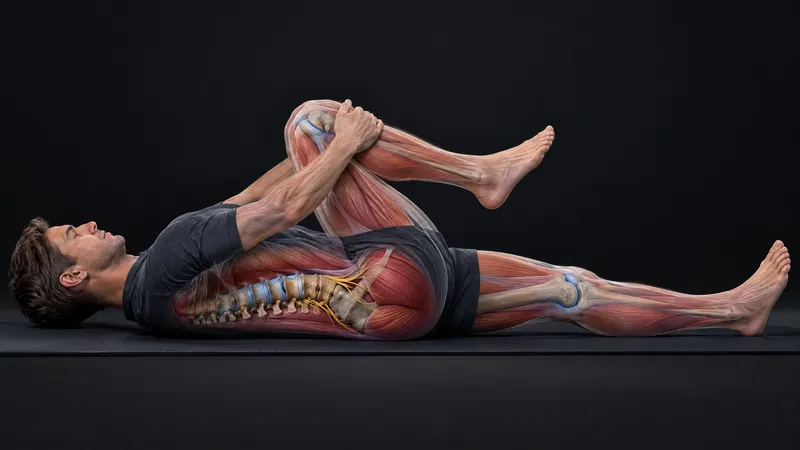
What stretching does for a sore back
Stretching feels good, and that isn't nothing. It gets you moving, it eases the guarding and stiffness that build up when you've been protecting your back, and it interrupts the long stretches of sitting still that tend to make things ache more. The NHS puts stretches on its "do" list for back pain, alongside staying active and using ice or heat packs, with the sensible qualifier that you stop if your pain gets worse and get it looked at 3.
Where we'd push back on the usual advice is the promise attached to it. When researchers compared different modes of exercise across 89 studies and 5,578 people with ongoing non-specific low back pain, stretching didn't separate from a true control group on either pain or function 5. The modes that did come out ahead were Pilates for pain, and resistance training and stabilisation/motor-control training for physical function 5. The authors themselves grade the overall quality of that evidence as low, so it isn't the last word, but it's the most direct comparison available, and it doesn't support "these five stretches will fix your back."
A broader review of 249 trials found exercise does beat no treatment or usual care for pain. For functional limitations (being able to get through your day), the benefit was real but small enough that it fell below the threshold the researchers had set in advance for a meaningful difference 4.
So: stretch, by all means. Just treat it as one part of staying mobile, not the treatment itself.
Before you start
Stretching is low-risk. In the Cochrane review, side effects turned up in 33% of exercise groups compared with 29% of comparison groups, and were mostly minor things like muscle soreness 4. But there are a handful of signs that mean stop and get help instead of pushing on.
Call 000 or go straight to an emergency department if back pain comes with any of:
- Numbness, tingling or weakness in both legs
- Loss of feeling around the genitals or anus, sometimes described as a saddle-shaped patch of numbness
- A new change in bladder or bowel control
- A change in sexual function 3
Book in with a GP or physiotherapist instead of self-managing if the pain came on very suddenly and severely, followed a significant fall or accident, comes with fever or feeling generally unwell, leaves you unable to walk or move, or arrives alongside unexplained weight loss 1. The same goes for pain that's clearly worse at night, worse when you sneeze or cough, or hasn't budged after a few weeks of looking after it at home 3.
None of that is meant to alarm you. Fewer than 1% of back problems turn out to be caused by a serious condition 2. It's the short list to know before you start.
Five gentle stretches you can start today
Work through these slowly. Nothing here should be sharp, and nothing here should send pain down your leg. A mild pulling sensation is fine; a spike isn't.
1. Knee to chest. Lie on your back with both knees bent, feet flat. Draw one knee up towards your chest with both hands and hold for 20 to 30 seconds. Lower it, then swap sides. Repeat 3 times each side.
2. Double knee to chest. Same starting position. Bring both knees up together, hands behind the thighs, and let your lower back settle into the floor. Hold for 20 to 30 seconds. Repeat 3 times.
3. Lower trunk rotation. Lie on your back, knees bent and feet flat, arms out to the sides. Let both knees roll slowly to one side, keeping both shoulders on the floor, until you feel a gentle stretch through the lower back. Hold 15 to 20 seconds, return to the middle, then roll to the other side. Repeat 5 times each way.
4. Child's pose. From hands and knees, sit your hips back towards your heels and reach your arms forward along the floor. Hold for 30 seconds, breathing out as you settle into it. Repeat 3 times. Pop a cushion between your heels and your backside if your knees don't love the position.
5. Cat-camel. On hands and knees, slowly arch your back up towards the ceiling, then let it sag gently towards the floor. That's one repetition. Move through it slowly, without holding at either end. Do 10 repetitions.
A heat pack on the lower back for 10 to 15 minutes beforehand can make the whole sequence more comfortable if you're stiff or spasming 3. Once through, once or twice a day, is plenty to start with. If your back has only just gone into spasm, start with our back spasm page before any stretching.
And the bit that matters more than the sequence itself: get up and move every hour or so through the day 2. Standing up, walking to the kitchen, rolling your shoulders: that regular interruption does more for a stiff back than one concentrated stretching session does.
Why your lower back won't loosen up
If you've been stretching diligently for weeks and nothing's shifting, that's worth taking seriously, and it isn't a reason to stretch harder.
Part of the answer is that stretching alone was never likely to do it, which is what the research showed 5. The other part is that ordinary low back pain isn't only a muscle-tightness problem. Lower activity levels, poor sleep, stress, anxiety and low mood, smoking, and sudden jumps in how much you're loading your spine all show up as contributors 2.
There's also a set of causes that a lot of stretch-routine content leans on, which the evidence doesn't support. Better Health Channel states it flatly: there is no evidence that back pain is caused by getting older, poor posture, a weak core, or everyday lifting and bending 2. If you've been told your back hurts because you sit badly or your core is weak, that's a much shakier claim than it's usually presented as.
When a back doesn't settle, the useful next question usually isn't "which stretch am I missing"; it's what's driving it, and what a structured program would need to look like.
Muscle or disc? How to tell the difference
This is the question we get most often, and the answer changes what you should do next.
Muscular or non-specific pain tends to sit in the back itself, feel achy or tight, move around a bit, and ease with movement and position changes. In 90 to 95% of cases, no specific cause for back pain is ever identified, and that's the normal, expected outcome, not a failed diagnosis 2. Acute back pain of this kind usually improves within three to six weeks 2.
Nerve-related pain behaves differently. It travels: down the buttock, the back of the thigh, sometimes past the knee into the calf or foot. It can burn, feel electric, or come with pins and needles. Sciatica is the name for that pattern, and it's a trapped or irritated nerve, not a muscle problem 3. When a disc in the lower back bulges and presses on a nearby nerve, the same picture can appear. A disc doesn't "slip" or move out of place, though, despite the phrase everyone uses 2. Reduced reflexes, reduced strength or changed sensation in the legs are the signs a clinician looks for to tell whether a nerve is involved 2.
One caveat: you can't reliably sort this out with a scan, either. Imaging usually can't identify the cause of back pain, and often shows age-related changes that are perfectly normal and not the source of your symptoms 1. That's a big part of why most cases are diagnosed without one 1.
If the leg symptoms are the dominant thing you're dealing with, the stretch sequence above isn't the right main event. Our pages on sciatica and lumbar disc bulge go through what each one involves and what a structured program for it looks like.
What actually works beyond stretching
If the goal is a back that holds up, not one that feels briefly looser, this is where the evidence points.
Keep moving. Staying active has been shown to be the most effective way of managing non-specific back pain, and resting the back often makes the pain worse 1. This is the single strongest recommendation in the whole set of sources, and it costs nothing.
Get a program with structure and progression. Pilates ranked highest for pain, with resistance training and stabilisation/motor-control training ranked joint-highest for physical function 5. What those have in common is progressive loading over weeks, something a five-minute routine can't replicate. Building that is what our exercise prescription and conditioning work is for.
Get it supervised if it's been going a while. For persistent pain (pain lasting more than three months), supervised exercise therapy with a physiotherapist or exercise physiologist, cognitive behavioural therapy, and multidisciplinary pain management are the approaches with support behind them 2. That's the territory our chronic pain management service works in.
Don't expect much from paracetamol. It hasn't been shown to be effective for acute or chronic back pain 1. Medication decisions sit with your GP or pharmacist, not with us, but it's worth knowing before you keep reaching for it.
FAQs
Should I stretch my lower back if it hurts?
Generally yes, gently. Stretches sit on the NHS's list of things to do for back pain, alongside staying active and using ice or heat, with the clear qualifier that you stop if your pain gets worse and see a GP 3. Just hold the expectation loosely: in a network meta-analysis of 89 studies, stretching didn't outperform a true control group for pain or function 5. Safe and reasonable for relief, not a treatment on its own.
What's the worst thing you can do for back pain?
Go to bed and wait it out. The NHS is explicit that you shouldn't stay in bed for long periods with back pain 3, and healthdirect notes that resting your back can often make the pain worse 1. Movement feels counterintuitive when something hurts, but it's the best-supported thing you can do.
How do you decompress the lower back at home?
"Decompression" is a marketing term more than a mechanism, and none of the sources we rely on support the idea that you can decompress a spine with a home routine. What they do support is plainer: stay active 1, gentle movement and heat for comfort 3, and getting up to move every hour or so instead of sitting still for long stretches 2. Age-related changes on a scan are also usually normal findings, not damage that needs undoing 1.
What are the "big 3" for lower back pain?
You'll see a specific named trio of core exercises marketed under that label online. None of the government health sources or peer-reviewed reviews we use name that protocol, so we won't attribute it to them. What the evidence does say is that stabilisation and motor-control training ranked joint-highest for improving physical function 5, so the underlying idea of training control through the trunk is sound, even if the branded version isn't something we can point to research for.
Is there an emotion "trapped" in my lower back?
Not in the way that phrase suggests, but the question is getting at something real. Stress, anxiety and low mood are listed among the contributors to ongoing non-specific back pain 2, and stress worsens pain partly through muscle tension, with mindfulness shown to reduce pain levels 1. Persistent pain also runs the other way, leading to fear of movement, irritability and low mood 2. So it's a real two-way relationship between stress and pain, not an emotion stored in your tissue.
What are 5 red flags of low back pain?
The ones that mean emergency care, not a stretch: numbness, tingling or weakness in both legs; loss of feeling around the genitals or anus (saddle anaesthesia); a new change in bladder or bowel control; and a change in sexual function 3. Add to those: pain that came on very suddenly and severely, pain after a significant injury or accident, fever or feeling unwell with the pain, being unable to walk or move, and unexplained weight loss 1. To keep that in perspective, fewer than 1% of back problems are caused by a serious condition 2.