What your calf is made of
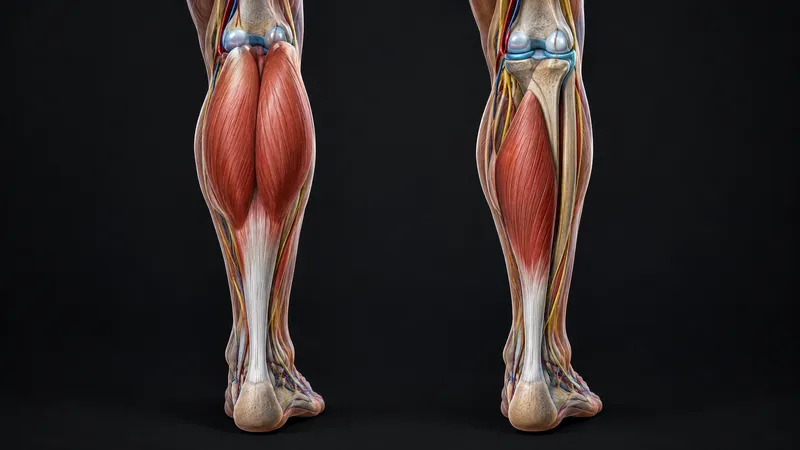
Two muscles do most of the work. The gastrocnemius and the soleus sit one on top of the other at the back of your lower leg, and their flat sheets of tendon merge into the Achilles, which anchors to your heel bone 1,2. There's a third, the plantaris, but it's largely vestigial and rarely involved when a calf gets injured 2, so you can mostly forget about it.
That's the whole structure. What makes the two main muscles behave so differently isn't size or position. It's where each one starts.
The gastrocnemius: the one you can see
The gastrocnemius is the shape people mean when they talk about having "good calves". It has two heads that start above the knee, run down the back of the leg, and join the Achilles.
Because it starts above the knee, it crosses two joints (the knee and the ankle) and it's densely packed with fast-twitch fibres built for quick, forceful movement 2. That combination is also why it's considered high risk for strains 2. A muscle that spans two joints can be stretched at both ends at once, and a muscle built for explosive speed gets asked to do explosive things.
The numbers back that up. The inner head of the gastrocnemius is the third most commonly strained muscle in elite athletes, behind only the hamstring and the front of the thigh 4. Injuries to the outer head turn up in as many as 14% of patients in some case series 4. The classic version has a nickname that's been around since 1883 ("tennis leg") and it describes what our first patient felt: sudden pain, swelling, and a leg that stops cooperating on the spot 2.
The soleus: the one doing the quiet work
The soleus is broad and flat and sits underneath the gastrocnemius, which is why most people have never heard of it despite using it constantly. It starts below the knee, so it crosses only the ankle 2.
It's also built differently. The soleus is mostly slow-twitch endurance muscle, though the usual flat statement oversells it. Human soleus tissue is predominantly slow-twitch, but the proportion ranged from 64% to 100%, averaging 80%, in one biopsy study 7. It's a tendency, not a rule.
A key job is posture. The soleus is built for the steady, low-level push at the ankle that keeps you balanced whenever you're standing 3. You're using it right now if you're on your feet, and you've been using it all day without noticing, which is the whole point of it.
On paper, all of that makes the soleus low risk for injury: one joint, slow fibres, no explosive demand 2. In practice it's not that simple, and nobody knows the true rate. Reported occurrence of soleus strain varies from rare to common depending on which study you read, and it's likely under-reported, partly because it gets misdiagnosed, and partly because a lot of research lumps soleus injuries in with gastrocnemius ones 2.
Why your calf gets called your "second heart"
This one comes up a lot, and there's a real mechanism behind the phrase. Your veins have to move blood from your feet back up to your heart, against gravity, whenever you're upright. Part of the venous system runs straight through the soleus, so every time the muscle contracts, it squeezes those vessels and helps push blood back towards the heart 3. That's the calf muscle pump, and it's why you'll see the soleus in particular described as a second heart.
It's also a nice illustration of what the muscle is for. A pump that works all day isn't built for sprinting. It's built for not getting tired.
So which one is stronger?
"Stronger" depends on what your knee is doing, and researchers have openly disagreed about the relative contribution of the two muscles 6, so anyone giving you a flat answer is skipping a step.
Here's the mechanism. Because the gastrocnemius crosses the knee, bending the knee slackens it. With the knee fully bent, the soleus becomes the main source of push at the ankle 2. Straighten the knee and it reverses: with the knee in full extension, the gastrocnemius provides the greater contribution to pushing off 2.
Walking splits the job again. Both muscles help hold you up, but the soleus is the primary contributor to driving your trunk forwards 6. The two can also swap roles within a movement: in one study both worked together as the calf shortened, but in some people the gastrocnemius took over from the soleus as the calf lengthened under load 8.
So: no winner. Two muscles doing different jobs, selected by knee angle.
Did you tear your soleus or your gastrocnemius?
This is the question most people arrive with, and the two injuries don't look alike.
A gastrocnemius tear usually has a moment attached to it. Sudden sharp pain during an explosive push-off, swelling and loss of function that show up immediately, and tenderness in the inner belly of the muscle or where muscle meets tendon 2.
A soleus problem usually doesn't. The pattern is calf tightness, stiffness and pain that worsen over days to weeks, often provoked by walking or jogging, with swelling and disability that stay mild 2. Nothing dramatic happens, which is why it gets ignored for a fortnight.
Two caveats. It isn't always one or the other: both muscles were involved in 17% of calf strains in one radiology study 2. And two-thirds of calf injuries happen right at the junction between the inner gastrocnemius and the soleus 4, the border between them, not cleanly in either muscle.
You probably don't need a scan to sort this out. The vast majority of calf injuries can be diagnosed and managed without any imaging at all 4. If you think you've strained something rather than just overloaded it, our calf strain page covers how the grades work and what recovery looks like; that's where the structured plan lives.
What a struggling soleus looks like
Because the soleus is a postural, endurance muscle 3, it tends not to fail loudly. What people describe instead is a calf that feels tight and stiff but not sharply painful, symptoms that build over days to weeks instead of arriving in a moment, and trouble that shows up during walking or jogging rather than during a single big effort 2.
We're not going to give you a rep count to test yourself against. The sources we rely on don't publish one, and inventing a threshold would be worse than useless. What we do in clinic is compare sides under the two knee positions and watch how the calf behaves under repeated load; that's a sports physiotherapy assessment, and it takes about fifteen minutes.
How to load each one
If you want to train the two muscles deliberately, knee position is the whole trick:
- Straight-knee calf raises: standing, legs straight, load the gastrocnemius 2.
- Seated or bent-knee calf raises shift the work towards the soleus, with the gastrocnemius contributing less 2.
Most people only ever do the first one, which means the muscle doing the postural work and most of the forward propulsion in walking 3,6 never gets trained directly.
If you're working around a current injury and not just training, the order matters and so does the timing: heel raises and calf stretches are appropriate once the acute pain has settled 1, and the general direction is to use the leg more, not rest it, because movement helps a calf recover 5. The progression belongs on the calf strain page, not here.
One note on the early days, since you'll find both pieces of advice online: Australian guidance says no heat in the first 48 to 72 hours 1, while UK NHS guidance says heat and ice both help with pain and you can use whichever feels better 5. Those two disagree. Neither is fringe advice, and we'd rather tell you that than pretend there's a settled answer.
If the tightness has outlasted the acute stage and won't shift, manual therapy is a reasonable addition alongside loading, though not in the first few days, when hands-on work can do more harm than good 1.
When calf pain isn't the muscle at all
Plenty of calf pain has nothing to do with the gastrocnemius or the soleus. Cramp and muscle strain are the common causes, but the same area can hurt because of Achilles tendinopathy or rupture, sciatica referring down the leg, diabetic peripheral neuropathy, compartment syndrome, or a deep vein thrombosis 1.
That last one is the reason this section exists. If your leg is red or swollen, see a doctor immediately. Those are signs of a possible DVT, and it's not something to wait out 1. The same applies if the calf is hot, swollen and tender 5. And if the lower leg looks misshapen after a significant injury, or you can't put weight through it at all, that's an emergency department or 000, not a physio appointment 5.
Short of that, the picture is reassuring. Most new or flared-up calf problems settle within about six weeks without needing a healthcare professional at all 5. In the first day or two, reduce what you're doing but keep moving as much as symptoms allow, and gently move your ankle and knee for 10 to 20 seconds every hour you're awake 5. After 48 hours, start using the leg more: exercise helps a calf and can relieve the pain 5. If six weeks have passed and it hasn't improved, that's the point to get it looked at properly 5.
FAQs
How can you tell if a calf muscle is torn or pulled?
"Pulled" and "torn" describe the same injury at different points on a spectrum, not two separate things. The signs that it's more than a niggle: sudden pain at the back of the leg, a calf that feels stiff or weak, difficulty rising onto your toes, and swelling or bruising 1. Being able to feel a gap or defect in the muscle suggests a more significant injury 2. Most calf injuries can be diagnosed and managed without a scan 4. Our calf strain page goes through the mild, moderate and severe grades and what each one means for your timeline.
Can walking strengthen calf muscles?
Walking uses your calves constantly: the soleus especially, since it's the muscle holding you upright and driving your trunk forwards with every step 3,6. It's also useful during recovery, because exercise and normal use help a calf settle 5. But using a muscle and training it are different things. None of the sources we rely on support walking as a way to build calf strength, so if that's the goal, loaded heel raises in both knee positions will do more than adding kilometres.
What causes weak calf muscles?
On the musculoskeletal side, the usual reasons are disuse after an injury or a period off your feet, a strain that was never fully rehabilitated, and ordinary age-related change. But weakness is also where calf symptoms start pointing away from muscle: a leg that feels weak, tingly or numb needs a doctor rather than a strengthening program, because nerve-related causes like sciatica and diabetic peripheral neuropathy present that way 1.
How long does it take to strengthen a calf muscle?
We won't give you a number for strength gains, because no source we trust publishes one. What is documented is recovery: most calf problems begin to settle within about six weeks without needing a clinician 5, and after a calf strain, typical return to usual activity is around 10 to 12 days for a mild strain and 16 to 21 days for a moderate one 1. Those are return-to-activity figures, not back-to-full-strength figures. The gap between the two is where most re-injuries happen.