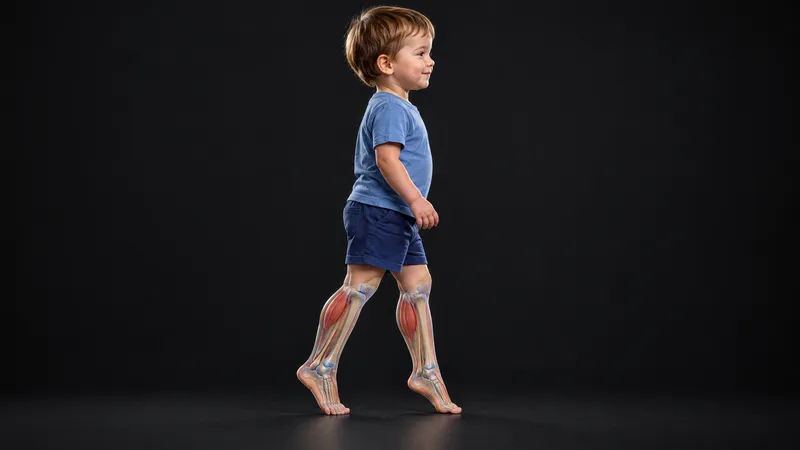
Toe walking: what it is
Idiopathic toe walking means a normal, healthy child walks on their toes for no known reason 1. "Idiopathic" is just the medical word for we don't have a cause for this; it isn't a diagnosis of something being wrong.
The useful test at home is simple. A child with idiopathic toe walking can usually stand and walk with their heels down when prompted 1. They toe walk by preference or habit, not because they physically can't get their heels to the floor.
On its own it generally doesn't cause harm (no pain, no deformities, often just a habit), though children who toe walk very frequently can end up with tight calf muscles 2.
When most children stop
Toe walking is a normal part of development and many children grow out of it, most commonly between the ages of 2 and 7 2. Children who are still toe walking past about age 2 are usually in the idiopathic group rather than the group with an underlying cause.
The longer-range numbers are more reassuring than most parents expect. In a population study of 1,436 five-and-a-half-year-olds, 4.9% had toe walked at some point, and more than half of those had already stopped by that age 4. By age 10, one cohort found 79% of everyone who had ever toe walked had developed a typical gait spontaneously, with no intervention and no tightening of the ankle 3.
Put plainly: most children come down onto their heels on their own, with age and weight 1.
What toe walking usually means
In most cases, nothing. The majority of toe walking is idiopathic: no discernible underlying cause 6.
In a small number of children, persistent toe walking can be associated with something else: a neurological condition such as cerebral palsy, a neuromuscular condition such as muscular dystrophy, or a neurodevelopmental difference such as autism 2. That list reads alarmingly, so it's worth being specific about how these are told apart: by the rest of the picture (the red flags in the next section), not by how the toe walking looks 2.
Toe walking and autism: the honest answer
This is the question most parents are really searching for, so here it is without hedging.
Toe walking is more common in neurodivergent children. In that same study of 1,436 children, toe walking (current or past) was found in 4.9% of the whole group, but in 41.2% of the children who had a neuropsychiatric diagnosis or developmental delay 4. Among the smaller group of children still toe walking at age 10, neurodevelopmental conditions were common 3.
And now the other half, which matters just as much: yes, plenty of non-autistic children toe walk. That 4.9% figure comes from a general population cohort, not a clinic. Toe walking is more common in autistic children, but most children who toe walk are not autistic, and toe walking alone is not a diagnosis of anything.
If you have other concerns about your child's development, those are worth raising with your GP or child and family health nurse, because of those concerns, not because of the way they walk.
When toe walking is worth getting checked
Most toe walking needs reassurance, not treatment. These are the things that do warrant a proper look 1,2:
- Your child toe walks only or mostly on one side.
- They can't put their heels flat while standing, even when asked.
- The toe walking started suddenly, after a period of walking normally with heels down.
- It's causing difficulty with activities: constant tripping or falling, or problems with balance.
- Their legs seem stiff, or there are other awkward or unusual movements.
- There's pain or discomfort in the calves.
One more practical trigger: if you've been trying stretches and heel-down activities at home and nothing has changed after about six months, that's a reasonable point to speak to a health professional 2.
What actually helps, and what the evidence says
This is the section where a physiotherapy practice is supposed to list treatments. We'd rather tell you what the research shows, which is less than you'd hope.
The headline: the management of idiopathic toe walking is controversial 1. The options that appear in the literature (shoe inserts, serial plasters, splints, botulinum toxin injections, stretches, or simply watching and waiting) are listed as options precisely because none of them has clearly won 1.
A 2019 Cochrane systematic review looked for trials of treatments for idiopathic toe walking and found only four, totalling 104 children, with only one contributing usable data. Its conclusion was that the certainty of the evidence was too low for conclusions to be drawn 5. An earlier 2016 review was more positive, reporting good evidence for casting and surgery, though only surgery held up beyond a year 6. Those two readings disagree, and we'd rather you knew that than be sold the flattering one.
Where the evidence does agree, it agrees on negatives:
- Adding botulinum toxin to casting doesn't improve results over casting alone: no clear difference in outcome, ankle range or recurrence, on very low-certainty evidence 5, a finding the 2016 review reports independently 6.
- Ankle-foot orthoses restrict toe walking while they're worn, and children revert once the brace comes off 6.
- Some children keep toe walking even after a course of treatment 2, and for autistic children in particular, treatment carries no guarantee of stopping it 2.
To be clear about our own scope: plasters, splints, injections and surgery are decisions for an orthopaedic or paediatric team, not something a physiotherapist provides. What does sit in our lane is everyday, low-risk stuff you can do at home anyway: daily calf stretches held for around 30 seconds, plus heel walking, standing on one leg, and walking heel-to-toe along a line 1.
One distinction the research draws: a child who has a tight, restricted ankle from early on is a different diagnosis (a short Achilles tendon, which needs treating early), not an idiopathic toe walker 3. That's part of what an assessment is for. Idiopathic toe walking itself was not found to cause calf contractures 3.
In-toeing (pigeon toes): why the feet turn in
In-toeing is when your child's feet point inward as they walk or run. The first thing worth saying is the blunt one from the paediatric orthopaedic guidance: "Intoeing is normal in children" 8.
It doesn't usually affect physical activity, and it doesn't increase the likelihood of problems like arthritis or back pain later in life 7.
Three different twists
In-toeing isn't one condition; it's three, depending on where along the leg the rotation sits 7,8:
| Where the twist is | What it's called | What usually happens |
|---|---|---|
| The front of the foot curves inward | Metatarsus adductus | Most improve without any treatment; severe cases may need a brace or special shoes 7 |
| The shinbone is rotated inward | Internal tibial torsion, often related to position in pregnancy | Usually corrects itself by around 8 years old 7,8 |
| The thigh bone is rotated inward | Internal femoral torsion (femoral anteversion) | Usually improves by around 9 to 10 years; some mild in-toeing can persist into adulthood 7,8 |
All three are rotational differences in how the bones sit; they're not neurological conditions. That's worth stating directly, because it's one of the most common fears parents arrive with.
When pigeon toes straighten out
In most cases, in-toeing gets better on its own by around 8 to 10 years old 7. Shin rotation tends to resolve first, around 8; thigh rotation later, around 9 or 10 7,8. Some children keep a mild degree of it as adults, and for most that causes no problem at all 7.
One useful thing you can do in the meantime: take a photo or short video of your child walking every six months 7. Change this slow is almost impossible to see day to day, and a comparison over a year tells you far more than watching them cross the lounge room tonight.
What doesn't help with in-toeing
This is the part we'd rather say plainly than leave you to discover after spending money on it.
For internal tibial torsion and internal femoral torsion, the paediatric orthopaedic position is that "there are no specific exercises, braces or special shoes that can help" 8. And from NSW Health's own parent factsheet: trying to change the way your child walks or sits "will not help with intoeing and can cause stress and anxiety" 7.
So if your child is happily running around with their feet turned in, correcting them every time they sit is more likely to make both of you miserable than to change the shape of their shinbone.
When in-toeing is worth getting checked
The signs that do warrant a look 8:
- The in-toeing is severe and isn't improving with time.
- It's causing tripping in a school-aged child that affects them joining in with activities.
- It affects only one leg.
What happens if you do get it looked at
In Australia, the usual first step for toe walking is reassurance and some simple calf-stretch education; that's what published pre-referral guidance for clinicians here recommends, and it's the advice most families end up with.
Referral onwards is reserved for specific pictures: toe walking on one side only goes to orthopaedics with a hip X-ray; bilateral toe walking over age six also goes to orthopaedics; under six, it goes to a child development service for physiotherapy. Where a medical or developmental cause is suspected, a paediatrician is the right destination. (That guidance is written for clinicians, so treat it as a map of the system, not advice about your child.)
Where physiotherapy fits
For a lot of families reading this, it doesn't need to, and we'd rather say that than imply otherwise.
What an assessment gives you is the difference between hoping this resolves and knowing whether it will. We'll watch your child move, check whether they can get their heels to the floor, look at whether the pattern is the same on both sides, and go through the red flags above with you properly rather than through a search bar at 11pm.
An assessment is not a commitment to treatment. If your child doesn't need physiotherapy, we'll tell you that, and in this particular corner of paediatrics, that's the most likely outcome. You can read more about how we work with children on our paediatric physiotherapy page. If your worry is about a baby rather than a walking toddler (a strong head-turn preference, or a flat spot), that's a different thing again, and we've written about torticollis in babies separately.
FAQs
What does autistic toe walking look like?
There isn't a distinctive "autistic" toe-walking gait you can identify by watching. None of the sources we rely on describes a visual signature that separates one cause from another, and we're not going to invent one. What distinguishes the causes is the surrounding picture, not the walk: whether it's one-sided, whether it came on suddenly, whether your child can get their heels flat, whether their legs are stiff or their movements awkward, and whether there's pain 2. That's a history-and-examination job, not something you can diagnose from the end of the hallway.
Do kids grow out of being pigeon toed?
Usually, yes. Most in-toeing resolves on its own by around 8 to 10 years old 7: roughly 8 for a rotated shinbone and 9 to 10 for a rotated thigh bone 7,8. A small number of people keep a mild degree of it into adulthood, and for most that never causes a problem 7.
Is walking pigeon toed linked to autism?
Not in anything we can source. The association reported in the research is with toe walking, not in-toeing 3,4; none of the paediatric factsheets or studies we've used connects in-toeing to autism at all. In-toeing is described as a normal rotational variation in children 8. If your question is really about toe walking, the numbers are in the autism section above.
Should I stop my child W-sitting?
The paediatric orthopaedic guidance here is hedged, and we'd rather quote it than tidy it up. Children with internal femoral torsion sometimes sit with their bottom between their heels, and on that: "There is no evidence that this is harmful, but it might be wise to avoid it" 8. That's the whole position. It's not proven to cause damage, and it's also not worth a daily battle, especially given that trying to change how your child sits doesn't improve in-toeing and can cause stress and anxiety 7.
Why do I toe walk as an adult?
Because in some cases toe walking simply continues into adulthood 2. Not everyone who toe walked as a child stops, and some keep it even after treatment 2. If it's new, painful, or on one side only, that's worth having looked at rather than assumed to be lifelong habit; the same red flags apply 1,2.