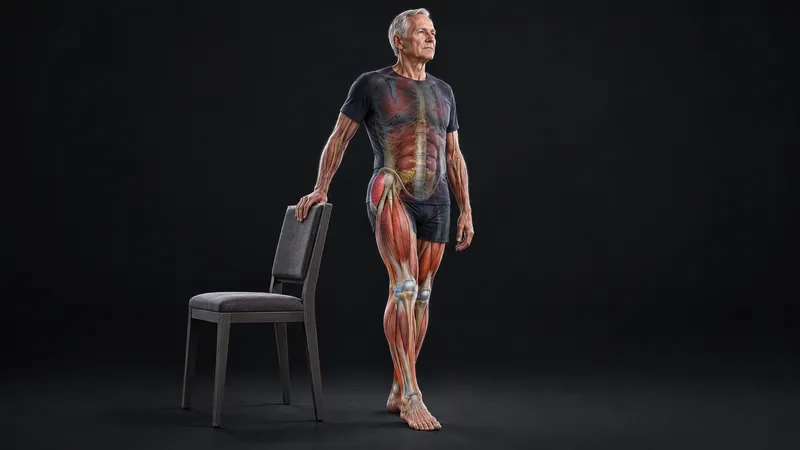
Why balance changes as you get older
Balance isn't one thing. It's your legs, your eyes, the sensation in your feet, your inner ear and your reaction time all working together, and it only takes one of those to drift for the whole system to feel less reliable.
The usual contributors are ordinary and unglamorous: muscles that have weakened and joints that have stiffened, reduced sensation in the feet and legs, poorer eyesight, and reaction times that have slowed 1,2. Sore feet or unsafe shoes matter more than most people expect 2. So does simply not moving much: the less you do, the faster the rest of it goes 2.
Then there's a second group that exercise alone won't touch. Blood pressure that drops when you stand up (postural hypotension). Medicines that cause drowsiness or unsteadiness, including sleeping tablets and opioids, and taking five or more medicines at once is itself a risk factor 1,2. Nerve damage in the feet from diabetes. Conditions like stroke, Parkinson's or arthritis. Incontinence, because rushing to the toilet is when a lot of falls happen 1.
That second list is the reason this page is a starting point rather than a solution. Exercises help with the first group. They do very little about the second, and the only way to know which one you're dealing with is to have someone look properly.
There's one more thing worth naming, because it's the quiet one: fear. Once you've had a stumble, it's natural to do less. Doing less makes you weaker, and being weaker makes the next fall more likely 2. Confidence isn't a soft outcome here; it's part of the mechanism.
What the research actually shows
This is the part most exercise lists skip, and it's the part that should decide what you spend your time on.
The best available evidence is a review of 108 randomised trials involving 23,407 people living in the community across 25 countries, average age 76 4. Exercise of any kind reduced the rate of falls by 23%, and reduced the number of people having one or more falls by 15%. Both of those are high-certainty findings, as solid as this sort of evidence gets 4.
But the review also found that the type of exercise makes a statistically significant difference 4:
- Balance and functional exercises: the kind described below, reduced the rate of falls by 24% (high certainty) 4.
- Multiple types combined, most often balance-and-functional work plus resistance training, probably reduced the rate of falls by around 34% (moderate certainty) 4.
- Tai chi may reduce the rate of falls by about 19%, but that particular finding is low-certainty 4. It's still recommended as a balance activity in Australian guidance 2.
- Walking programs, dance, and resistance training on its own: the review states plainly that it is uncertain what effect these have on the rate of falls 4.
Don't skip past that last point. Walking is good for you for plenty of reasons. It is not, on the current evidence, a falls-prevention program.
The limits matter just as much. The review's findings on fractures, falls needing medical attention and hospital admissions are all low or very low certainty, much weaker than the headline numbers 4. It also found exercise may make little important difference to health-related quality of life 4. And most of the included trials had unclear or high risk of bias. So: exercise reliably reduces how often you fall. Whether it reliably keeps you out of hospital is a claim the evidence doesn't yet support.
Before you start
Balance training is low-risk. In the trials that reported them, side effects were predominantly non-serious and mostly musculoskeletal; 14 trials reported none at all 4. Two serious events were recorded across the whole review 4. But a few sensible things first.
- Do the exercises near a wall or a stable chair, just in case you lose your balance 3. Not a dining chair on castors.
- Check with your GP before starting a physical activity program, particularly if you have a heart condition, take several medicines, or get dizzy or light-headed 2.
- If you've had a fall, speak with your doctor, even if you feel fine 1. Falling more than once in the past six months raises the risk of falling again 1, and a fall can be the first sign of something that needs treating rather than training.
- Stop if something hurts sharply, and don't push through dizziness.
Five balance exercises you can start today
These five come from the NHS's published balance routine, with its own recommended doses 3. Work through them slowly; the goal is control, not speed.
1. Sideways walking. Stand with your feet together and your knees slightly bent. Step sideways, slowly and in a controlled way, moving one foot then the other. Take 10 steps each way 3.
2. Simple grapevine. Cross one foot over the other and keep walking sideways. Take 5 cross-steps to each side. The smaller the step, the harder your balance has to work 3.
3. Heel-to-toe walk. Walk forward placing your heel directly in front of the toes of your opposite foot, as though you're on a line. Keep looking forward, not down. At least 5 steps 3.
4. One-leg stand. Face a wall with your fingertips lightly touching it. Lift one leg and hold for 5 to 10 seconds. Do 3 on each side 3.
5. Step-up. Using a step with a railing, or one close to a wall, step up slowly and under control, then back down. Up to 5 steps with each leg 3.
The NHS recommends doing these at least twice a week, alongside strength, flexibility and sitting-exercise routines 3. Twice a week done properly beats seven days of good intentions.
A ten-minute starting routine
If you want a single short session to begin with, the five exercises above fit comfortably into about ten minutes at the doses given.
| Order | Exercise | Dose 3 | Roughly |
|---|---|---|---|
| 1 | Sideways walking | 10 steps each way | 2 min |
| 2 | Simple grapevine | 5 cross-steps each side | 2 min |
| 3 | Heel-to-toe walk | at least 5 steps | 2 min |
| 4 | One-leg stand | hold 5–10 sec, 3 each side | 2 min |
| 5 | Step-up | up to 5 steps each leg | 2 min |
Be clear about what ten minutes is, though. It's a starting point, not the full dose. Australian guidance is that older people should aim for two to three hours of physical activity every week: at home, at a community class, or following a program from a physiotherapist 1. A short balance session sits inside that, it doesn't replace it.
Can you hold ten seconds?
There's one simple self-check. Researchers tested 1,702 people aged 51 to 75 on whether they could stand on one leg for ten seconds. Just over one in five (20.4%) could not 5.
Over roughly seven years of follow-up, the people who couldn't complete it had a higher rate of death from any cause than those who could, even after accounting for age, sex, body weight and existing health conditions 5. The authors note that balance tends to fall away quickly after the mid-fifties 5.
Read that carefully, because it gets misreported constantly. This was an observational study, not a trial. It shows an association. It does not show that practising standing on one leg extends your life. The authors themselves flag that things like recent falls and physical activity levels weren't controlled for, and the group studied was 68% men, all from a single exercise-medicine clinic in Brazil 5.
So treat it as a prompt, not a verdict. If you can't hold ten seconds comfortably (near a wall, please), that's useful information and a good reason to get assessed. It is not a judgement on your health.
When exercises aren't the answer
Some unsteadiness doesn't respond to balance training, and recognising which kind you have saves you months of doing the wrong thing.
If the room spins, if you get a swimming feeling when you roll over in bed, or if turning your head quickly brings on vertigo, that points towards the inner-ear balance system rather than towards strength. That needs a different examination altogether. Start with vertigo and dizziness or vestibular physiotherapy instead.
If you feel faint or grey-out when you stand up, that's a blood-pressure question for your GP, not an exercise one 1.
If you're on five or more medicines, or you've started something new and felt unsteadier since, that's worth a medication review 1,2.
If your eyesight has changed, or your feet have lost sensation, or your shoes are worn through, those are all fixable, and none of them are fixed by exercises 1,2.
And a practical note: around half of all falls happen in and around the home 1,2, and people over 85 are the most likely to be seriously hurt 2. Falls are also the reason behind about 9 in 10 hospital admissions for hip fracture 1. Knowing what to do if you do go down (roll onto your stomach, crawl to something stable like a sturdy chair, and push up using your strongest leg) is worth practising before you need it 2.
Where this fits with a structured program
If these five exercises feel manageable and you just want to stay ahead of things, keep going. Twice a week, near a wall, building gradually.
If any of the following are true, the exercises are the wrong place to stop:
- You've already had a fall, or more than one near-miss you haven't mentioned to anyone
- You're planning your day around your balance: avoiding stairs, going out less, declining things
- You can't hold the one-leg stand at all, on either side
- You're not sure whether your unsteadiness is weakness or dizziness
That's the point where an assessment earns its keep, because it identifies which of the causes above is yours. Our falls prevention page explains what that involves. If what you need is the strength half of the equation (the resistance training that the evidence pairs with balance work for the better result 4), that's exercise prescription and conditioning.
A physiotherapist can design an exercise program that suits you 2, and that's the difference between a list like this one and a plan: a list is the same for everyone, and a plan is built around your legs, your house and what you're trying to keep doing.
FAQs
What is the best exercise to improve balance in the elderly?
There isn't a single best exercise, but there is a best category. Balance and functional exercises, like the five above, reduced the rate of falls by 24% across 108 trials, and that's a high-certainty finding 4. Combining them with resistance training probably does better again, at around 34% 4. What doesn't have established evidence for falls prevention is walking on its own, dance, or resistance training by itself 4. If you only have time for one thing, make it balance work you can gradually make harder.
What are five exercises that seniors can do every day?
The five in the routine above: sideways walking, the simple grapevine, the heel-to-toe walk, the one-leg stand and the step-up 3. One correction to the question, though: the published recommendation is at least twice a week, not necessarily every day 3, alongside strength and flexibility work. Consistency across the week matters more than daily repetition, and rest days aren't cheating.
What are some good balance exercises for seniors in Australia?
The same five work perfectly well here. What's specific to Australia is the surrounding guidance: aim for two to three hours of physical activity a week, whether that's at home, at a community exercise class, or following a program from a physiotherapist 1. Home and group exercise programs and tai chi are both recommended, and the standing advice is to check with your GP before starting 2. If you'd like that built into a structured plan, that's what our falls prevention program is for.
How long should a 70 year old be able to balance on one leg?
Ten seconds is a useful benchmark. In a study of 1,702 people aged 51 to 75, 20.4% could not hold a one-legged stance for ten seconds 5. The NHS routine asks for a slightly gentler version: hold 5 to 10 seconds, three times on each side, with your fingertips on a wall 3. Two caveats: the ten-second research is observational, so it shows an association rather than cause and effect 5, and being unable to do it isn't a diagnosis. It's a reason to get assessed.
What exercises are not recommended for seniors?
No health authority we'd cite publishes a list of banned exercises, and you should be sceptical of pages that claim one. What the evidence does support is more useful: walking programs, dance and resistance-only programs have uncertain effects on falls 4; they're not harmful, they're just not falls prevention on their own, so don't substitute them for balance work. Reported side effects from exercise trials were predominantly non-serious and mostly musculoskeletal 4. The practical advice is to check with your GP before starting a program 2, do balance work near a wall or stable chair 3, and leave the ladder alone; climbing to reach things is a real, avoidable risk 2.